
How to Start Fish Trading Business in Dubai
Dubai has always had a deep connection with the sea. Long before the skyscrapers, the dhows were already out in the Persian Gulf — bringing in fresh fish, building livelihoods, and feeding communities. That tradition lives on today in a much more modern and commercially exciting form. Starting a fish trading business in Dubai in 2026 is not just a viable idea — it is a genuinely profitable one, backed by strong demand, world-class infrastructure, and a market that is expanding at impressive speed.
The UAE seafood market stood at USD 1.2 billion in 2024 and is forecast to reach USD 2.2 billion by 2032, growing at a compound annual rate of nearly 9%. Dubai residents consume around 33 kilograms of seafood per person each year — almost double the global average. Add to that the city’s millions of tourists, its thriving restaurant scene, its hotel industry, and its role as a global re-export hub, and you start to see just how large and layered the demand for fish really is.
This guide covers everything you need to know — from market opportunities and license types to documents, approvals, costs, and a step-by-step setup process — so you can start your fish trading business in Dubai with complete clarity.
Why Start a Fish Trading Business in Dubai?
Before jumping into the process, it helps to understand why Dubai is one of the best places in the world to enter the seafood trade.
Enormous and consistent local demand. Dubai’s multicultural population of over 3.5 million people includes large communities from South Asia, Southeast Asia, East Africa, and the Arab world — all cultures with strong traditions of fish consumption. Demand is not seasonal; it is constant and growing year-round.
Strategic location for import and export. Dubai sits at the crossroads of Asia, Europe, and Africa. Jebel Ali Port — the largest port in the Middle East — and Dubai International Airport give you direct access to sourcing fish from major fishing nations and re-exporting processed or packaged seafood to global markets. This is a massive competitive advantage that few cities in the world can offer.
Growing industry. The fresh fish sector in the UAE is forecast to grow by 3.33% annually from 2025 to 2030. The broader fish industry has already grown at 4.7% per year from 2020 to 2025. These are not speculative projections — this is a sector with proven, sustained momentum.
Tax-free business environment. Dubai’s zero personal income tax and 0% import duty on seafood (in most free zone setups) make profit margins significantly more attractive than in most other markets worldwide.
Diverse revenue channels. As a fish trader in Dubai, you can sell to wholesale markets, retail fish shops, supermarkets, restaurants, hotels, catering companies, and online delivery platforms — giving your business multiple income streams rather than dependency on a single buyer type.
Government support. Dubai’s Department of Economy and Tourism (DET), Dubai Municipality, and the Ministry of Climate Change and Environment all have structured systems in place to license, regulate, and support food trading businesses — providing a stable, transparent legal framework.
Types of Fish Trading Businesses You Can Start in Dubai
Fish trading is not a single business model — it covers a wide range of activities, each with its own customer base, operational requirements, and profit potential. Before applying for a license, decide which type of business suits your resources and goals.
Wholesale Fish Trading
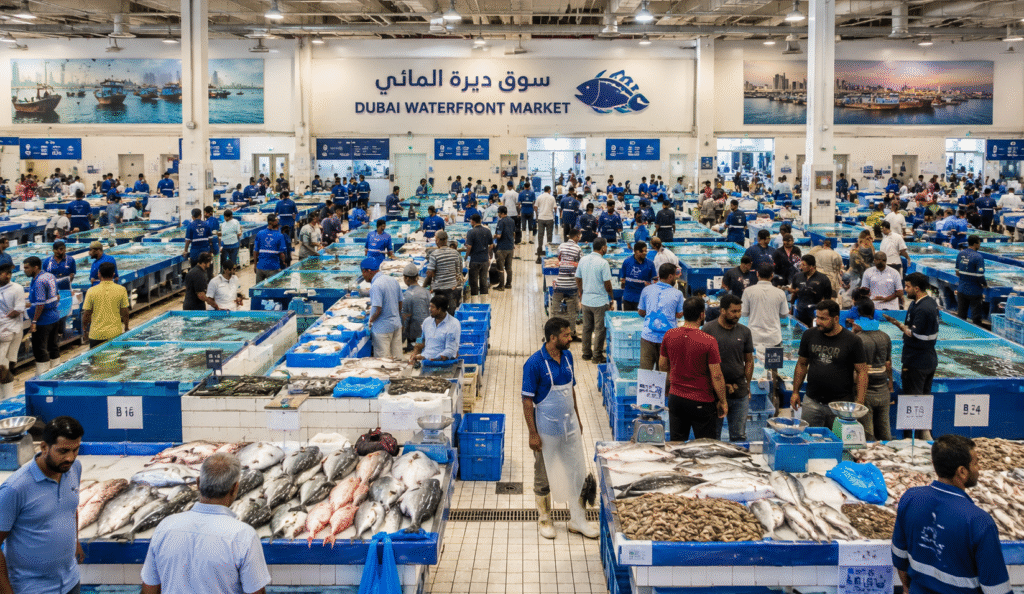
This is the backbone of the industry. You source fish in bulk — from local fishermen, fishing cooperatives, or international suppliers — and sell it at wholesale prices to retailers, restaurants, hotels, and food processing companies. The Deira Waterfront Market (formerly the Deira Fish Market) is the primary hub for wholesale fish trading in Dubai, operating daily and serving hundreds of buyers.
Fresh Fish Retail
A retail fish shop sells directly to end consumers. This model works well in high-footfall areas like Deira, Karama, and Satwa for budget-conscious buyers, and in premium locations like Jumeirah and Dubai Marina for upscale customers seeking imported and specialty fish varieties.
Frozen Fish and Seafood Trading
Specializing in chilled and frozen seafood — including fish fillets, shrimp, squid, and crab — gives you a longer shelf life and the ability to source and distribute globally without the same time pressure as fresh fish. This model is particularly well-suited for import-export operations and free zone setups.
Fish Import and Export
Dubai’s position as a global re-export hub makes it an ideal base for fish import-export businesses. You can import fish from major seafood-producing countries such as India, Norway, China, and Iceland, then re-export to markets across the Middle East, Africa, and Europe. This model requires customs clearance processes and stricter regulatory compliance but offers higher margins.
Online Seafood Delivery
A rapidly growing model in the UAE, online fish and seafood delivery services allow you to reach customers directly through your own website, app, or platforms like Talabat, Noon Food, and Careem. This model pairs well with a physical trading or wholesale operation.
Processed and Value-Added Seafood
Beyond raw fish, you can add value through processing activities — filleting, marinating, packaging, or smoking — and sell to premium retail channels or export markets. This requires an industrial license and appropriate processing facilities.
Licenses Required for a Fish Trading Business in Dubai
Getting the right license is not just a legal formality — it defines what you are legally allowed to do and which markets you can access. Here is what you need:
Commercial or Foodstuff Trading License
For most fish trading activities, the primary requirement is a commercial license from Dubai’s Department of Economy and Tourism (DET), with the appropriate business activity code. Relevant codes include:
- Frozen Fish and Seafood Trading (4721.72) — for chilled and frozen seafood
- Fresh Fish Trading — for fresh fish retail or wholesale
- General Foodstuff Trading — covers a broader range of food products including fish
If you are operating through a free zone, the same activities can be licensed under a free zone commercial license from authorities like JAFZA (Jebel Ali Free Zone Authority) or Dubai South Business Hub.
Fishing License (If Applicable)
If your business model involves directly catching fish rather than just trading it, you will also need a separate fishing license from the Dubai Municipality’s Environment Department. This requires a boat license, proof of residency, and employment contracts for any fishing crew.
Regulatory Approvals You Must Obtain
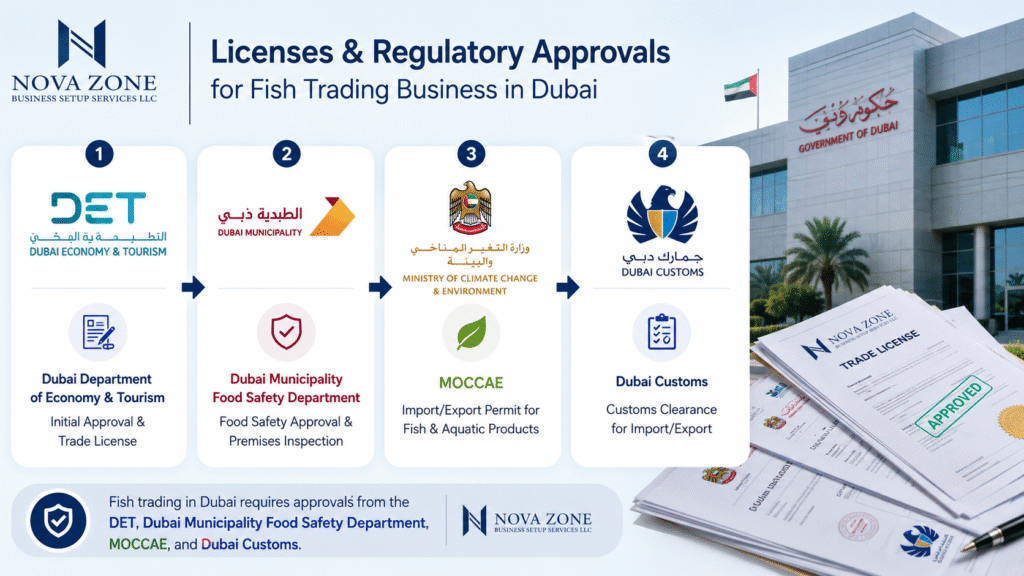
Fish trading in Dubai is a regulated industry due to food safety requirements. In addition to your trade license, you must secure approvals from multiple government bodies. Skipping any of these is not an option — it can result in license rejection, fines, or operational shutdown.
Dubai Municipality — Food Safety Department
The Dubai Municipality’s Food Safety Department is the primary regulatory body for all food businesses in Dubai, including fish traders. You must register your business with this department and ensure your storage, handling, and cold-chain processes comply with their food safety guidelines. For businesses involving wholesale fish, fresh fish, and frozen seafood, pre-approval from the Food Safety Department is typically required before your license is issued.
Ministry of Climate Change and Environment (MOCCAE)
MOCCAE oversees fish import and export activities at a federal level. If your business involves importing or exporting fish and seafood products, you need to register with MOCCAE and ensure all products comply with UAE standards for origin certification, health certificates, and species protection requirements.
Dubai Customs
For import and export operations, Dubai Customs clearance is required on every shipment. You will need to register as an importer/exporter, ensure proper labeling (including Arabic labels on all food products), and submit the correct documentation with each consignment.
Food Importer Registration System (FIRS)
Businesses importing food products — including fish — into Dubai must register with the Food Importer Registration System, which is managed jointly by Dubai Municipality and relevant federal authorities. This registration is mandatory before you can legally bring any seafood products through Dubai’s ports.
Documents Required to Start a Fish Trading Business in Dubai
Once you know which license and approvals you need, gather the following documents before beginning the application process:
- Passport copies of all shareholders and company directors
- UAE residence visa copies (for residents)
- Passport-size photographs
- Three proposed company name options
- Business plan (required for some license types and free zone applications)
- Trade name approval certificate (obtained from DET or the relevant free zone authority)
- Memorandum of Association (MoA) — for LLC structures
- Commercial tenancy contract (Ejari-registered) for your business premises
- Health and safety certifications for your facility
- Food safety compliance documentation (where applicable)
- Health certificate and origin certificate for imported fish consignments
- Cold-chain storage documentation (if handling fresh or chilled seafood)
Step-by-Step Guide to Starting a Fish Trading Business in Dubai
Here is the complete process from first decision to open-for-business:
Step 1: Choose Your Business Model and License Type Decide what type of fish trading you want to do — wholesale, retail, import-export, frozen seafood, or a combination. This determines whether you need a mainland license from DET or a free zone license, and which specific activity codes apply to your business.
Step 2: Choose Your Jurisdiction — Mainland or Free Zone For businesses targeting the local UAE market (selling directly to consumers, restaurants, and retailers), a mainland license from DET is the right choice. It gives you unrestricted access to the domestic market.
For businesses focused on import, export, or re-export of seafood, a free zone license (JAFZA, Dubai South, or Dubai Maritime City) offers advantages including 100% foreign ownership, zero customs duties on imported goods, and proximity to port facilities.
Step 3: Reserve Your Company Name Submit three proposed company names to DET or your chosen free zone authority. Names must be unique, not already registered, and compliant with UAE naming guidelines — avoid religious references and names that could be considered offensive.
Step 4: Apply for Initial Approval Submit your application to DET (for mainland) or your free zone authority. At this stage, you will declare your business activity and receive initial approval to proceed with the remaining steps.
Step 5: Secure Your Business Premises Location matters enormously in the fish trading business. Key options include:
- Deira Waterfront Market — Ideal for wholesale trading; Dubai’s most active fish market
- Al Aweer — Well-established area for food wholesale businesses
- Jumeirah and Dubai Marina — Premium retail locations for high-end seafood
- JAFZA or Dubai Maritime City — Ideal for import-export operations close to port facilities
- Al Quoz and DIP — Cost-effective industrial zones for wholesale and B2B supply
Retail shop rental in areas like Deira or Al Aweer typically costs between AED 50,000 and AED 200,000 per year, depending on size and exact location. Free zone warehouse facilities vary based on size and the specific zone chosen.
Step 6: Obtain Dubai Municipality Food Safety Approval Register your business with the Dubai Municipality Food Safety Department and have your storage facility inspected. Ensure your cold-chain infrastructure, hygiene standards, and handling processes meet their requirements before inspection.
Step 7: Register with MOCCAE (if importing/exporting) Complete your registration with the Ministry of Climate Change and Environment. This is mandatory if any of your fish products are being imported from or exported to international markets.
Step 8: Register with the Food Importer Registration System (FIRS) Complete your FIRS registration to legally bring fish into Dubai through the port system.
Step 9: Submit Full License Application With all approvals in hand, submit your full license application to DET along with the Ejari-registered tenancy contract, MoA, and all supporting documents. Pay the applicable government fees.
Step 10: Receive Your Trade License Once all documentation is approved and fees are cleared, your trade license is issued. Seafood trading licenses are valid for one year and must be renewed annually.
Step 11: Open a Corporate Bank Account Open a UAE corporate bank account to manage your business transactions. You will need your trade license, MoA, establishment card, and shareholder documents to complete the account opening process.
Cost of Starting a Fish Trading Business in Dubai
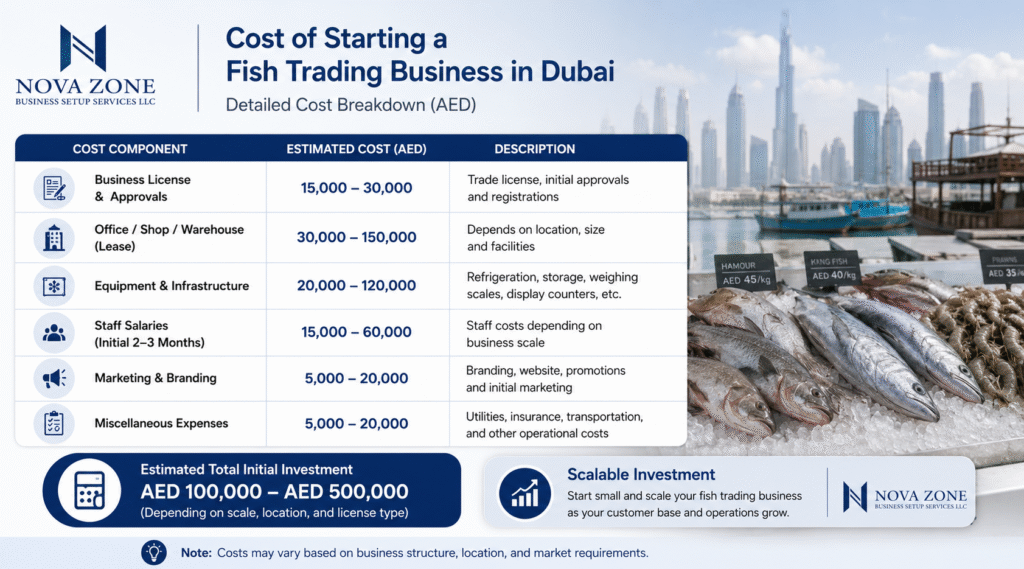
The total investment depends heavily on your scale of operation, license type, and location. Here is a general overview of the key cost components:
| Cost Component | Estimated Range (AED) |
|---|---|
| Trade License Fee (DET Mainland) | AED 12,000 – AED 20,000 |
| Dubai Municipality Food Safety Approval | AED 2,000 – AED 5,000 |
| MOCCAE Registration (if applicable) | AED 1,000 – AED 3,000 |
| Business Premises (annual rent) | AED 50,000 – AED 200,000 |
| Cold Storage Equipment | AED 15,000 – AED 80,000 |
| Staff and Labour Costs (monthly) | AED 5,000 – AED 20,000+ |
| Initial Inventory / Stock | AED 20,000 – AED 100,000 |
| Total Setup Range | AED 100,000 – AED 500,000 |
The lower end of this range applies to a small-scale retail or wholesale operation. Large-scale import-export businesses or those setting up cold storage processing facilities will sit at the higher end. Free zone setups may carry additional warehouse rental costs but can offset these through savings on customs duties.
Best Locations to Sell Fish in Dubai
Where you set up your operation will significantly influence your revenue and daily foot traffic. Here are the top locations worth considering:
Deira Waterfront Market — Dubai’s largest and most prominent wholesale fish market. Hundreds of buyers pass through daily, including restaurant owners, supermarket buyers, and catering companies. This is the beating heart of fish trading in the city.
Al Aweer — A major hub for food wholesale businesses in Dubai. Close to the Al Ain Road and well connected to delivery routes across the UAE.
Jumeirah and Dubai Marina — Premium retail zones where health-conscious expats and high-spending residents actively seek quality imported seafood and ready-to-cook options.
Deira, Karama, and Satwa — Dense residential areas with large South Asian and Southeast Asian communities — populations with some of the highest per-capita fish consumption in the city.
Jebel Ali Free Zone (JAFZA) and Dubai Maritime City — The top choices for import-export operations, offering proximity to Jebel Ali Port and streamlined customs processes.
Frequently Asked Questions About Fish Trading Business in Dubai
What license do I need to start a fish trading business in Dubai? You need a commercial or foodstuff trading license from Dubai’s Department of Economy and Tourism (DET) with the relevant seafood trading activity code. You will also need approvals from the Dubai Municipality Food Safety Department and, for import-export operations, MOCCAE and Dubai Customs.
Can a foreigner own 100% of a fish trading business in Dubai? Yes. Through a UAE free zone setup — such as JAFZA or Dubai South — foreign investors can own 100% of their company. On the mainland, recent legal reforms also allow 100% foreign ownership for most commercial activities without a local sponsor.
How much does it cost to start a fish trading business in Dubai? Initial setup costs typically range from AED 100,000 to AED 500,000, covering the trade license, government approvals, business premises, cold storage equipment, initial inventory, and staffing costs.
Do I need a separate fishing license if I want to catch and sell fish? Yes. If your business model involves directly catching fish, you need a separate fishing license from the Dubai Municipality’s Environment Department, which requires a boat license, proof of residency, and employment contracts for your crew.
What are the best products to trade as a fish business in Dubai? High-demand products include hammour, kingfish, safi, shrimp, crab, squid, and imported varieties like salmon and tuna. Frozen and processed seafood also carries strong demand from supermarkets, hotels, and institutional buyers.
How long does it take to get a fish trading license in Dubai? Timelines vary based on jurisdiction and the number of approvals required. A straightforward mainland commercial license typically takes one to three weeks. Cases requiring MOCCAE registration and multiple municipal approvals may take four to six weeks in total.
Where can I sell fish in Dubai? Your main sales channels include wholesale markets (Deira Waterfront Market), supermarkets, restaurants, hotels, catering companies, and online delivery platforms. Many fish traders supply multiple channels simultaneously to diversify revenue.
Final Thoughts
The fish trading business in Dubai is one of the most opportunity-rich sectors in the city’s food economy. The demand is real, the infrastructure is world-class, and the legal framework — while detailed — is structured and navigable once you know the steps. The key is to choose the right business model, get the correct license and approvals in the right order, secure a location that fits your buyer profile, and build supplier relationships you can depend on.
Dubai’s seafood market will keep growing. The question is whether you are positioned to grow with it.
Let Novazone Business Setup Services Handle Your Setup
Starting a fish trading business in Dubai involves multiple licenses, several government approvals, and a setup process that needs to be done in the right sequence. Getting any part of it wrong can cause costly delays.
That is where Novazone Business Setup Services comes in. We are a trusted UAE business setup consultancy with deep experience helping entrepreneurs and investors launch food and trading businesses in Dubai — from the initial license application right through to government approvals, corporate bank account opening, and visa processing.
Whether you are setting up a wholesale fish operation, an import-export seafood company, or a retail fish shop, our team at Novazone will guide you through every step, handle your paperwork, liaise with the relevant authorities, and make sure your business is up and running as quickly as possible.
📞 Contact Novazone Business Setup Services today and let us take the complexity out of your Dubai business setup — so you can focus on building your fish trading business from day one.